MC-ICP-MS trace element analysis and thin-section microscopy to examine variation in archaeological ceramics from submerged and terrestrial sites in La Altagracia, Dominican Republic
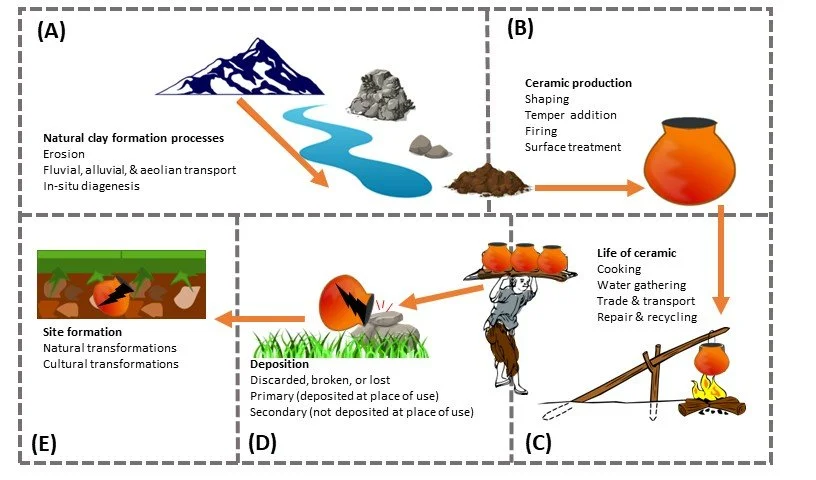
Stages in the life of a ceramic object that may impact its geochemical makeup: (A) clay sourcing, (B) ceramic manufacturing, (C) ceramic use and/or transport, (D) artifact deposition, and (E) archaeological site formation. Note that (D) depicts initial deposition into the environment, which marks the beginning of archaeological site formation (E)
Kirsten M. Hawley, Shelby T. Rader, Charles D. Beeker, Claudia C. Johnson
Year: 2025
abstract
This study evaluates geochemical variation in archaeological ceramics from three pre-Columbian sites in La Altagracia, Dominican Republic. We compare compositional variation of ceramics between a submerged site and two terrestrial sites using inductively coupled plasma mass spectrometry (ICP-MS) trace element analysis supplemented with thin section microscopy. Contrary to expectations, greater variation in trace element concentrations of the metals vanadium (V), copper (Cu), tantalum (Ta), zirconium (Zr), and uranium (U) exist between submerged and terrestrial sites in close geographic proximity to one another than between more distant terrestrial sites. Thin section analysis identified more void space in submerged than terrestrial samples but no major mineralogical differences. While precise mechanisms driving geochemical variation between sites remain unclear, post-depositional ion exchange between ceramics and the fluid in which they are submerged may have resulted in significant changes to their composition, reflected in discrepancy between ceramics from terrestrial and submerged contexts. Results of this research emphasize the need to consider post-depositional alteration in ceramic provenance studies, especially in submerged contexts.
